
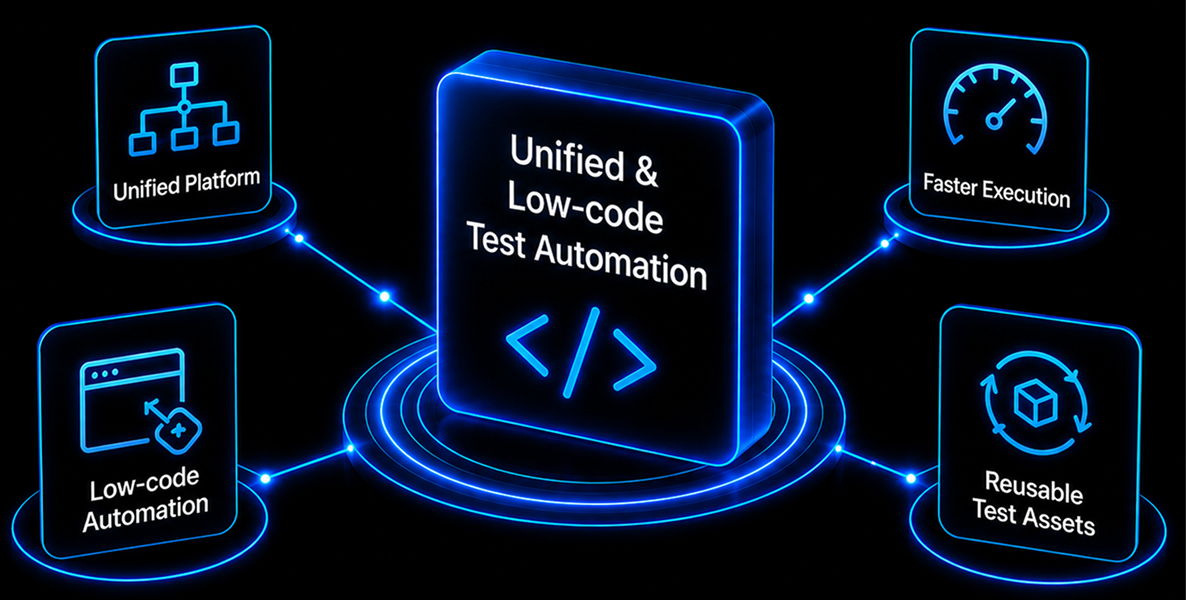
Enterprise Quality Engineering
Unified Low-Code Test Automation
Web · Mobile · APIs · Enterprise Applications
Accelerated Testing with Maximum Coverage
Our client — an enterprise product organisation operating across web, mobile, and APIs — had accumulated disconnected testing toolchains across their platforms over time. Each surface had its own test logic, its own maintenance burden, and its own failure patterns, creating silos that made shared quality visibility nearly impossible.
As deployment frequency increased, the cost of maintaining these fragmented workflows compounded. The team needed a way to scale coverage without scaling headcount proportionally — but lacked the unified foundation to make that possible.
Each platform operated with its own separate automation approach, making it impossible for the client's team to maintain a single, coherent view of product quality across web, mobile, and APIs.
Without shared components or reusable frameworks, keeping test suites current across platforms consumed engineering time that should have gone toward shipping product.
Differences in how tests were authored and executed across surfaces led to unpredictable outcomes and eroded the team's trust in their own automation results.
Fragmented coverage meant critical business flows weren't being validated end-to-end before deployment — leaving the client exposed to regressions that only surfaced in production.
We designed a consolidated testing strategy that brought web, mobile, API, and enterprise application coverage under a single governance model and shared execution framework.
We built reusable, low-code automation libraries that empowered both technical and non-technical team members to author, extend, and maintain tests without deep scripting expertise.
We standardised test patterns and execution configurations to ensure consistent behaviour and reliable results whether tests ran against web, native mobile, or API surfaces.
We embedded the unified framework directly into delivery pipelines, enabling automated quality gates and fast feedback at every stage of the build and release process.
We established centralised test asset management, enabling teams scale coverage across new applications & environments without rebuilding from scratch each time.

Connecting automated test suites to public device cloud platforms - enabling on-demand execution across real devices without maintaining local infrastructure.

Verifying that the application functioned correctly and remained usable across every supported locale - validating language rendering, formatting, and locale-specific behaviour.

Structuring tests to be authored once and executed across both Android and iOS - eliminating duplicated effort and ensuring consistent coverage from a single source.

Managing test datasets across environments and locales - ensuring every test ran with accurate, environment-appropriate data and reducing failures from mismatched inputs.

Introducing standardised test patterns across the codebase - bringing uniformity and readability while accelerating the automation of new test cases as the product evolved.

Configuring the framework to run tests across multiple environments, platforms, and datasets simultaneously - maximising coverage without additional authoring effort per configuration.

By eliminating fragmented, platform-specific testing workflows, we significantly reduced the time from feature completion to validated, shippable release.
Critical business flows were consistently validated across web, mobile, and API surfaces - giving every team a shared, reliable signal before each deployment.
Reusable low-code assets and standardised patterns meant our engineers spent far less time on test maintenance and far more time on coverage that actually mattered.
The unified framework scaled naturally across new applications and integrated systems, giving the organisation a quality engineering foundation built to grow with the product.