
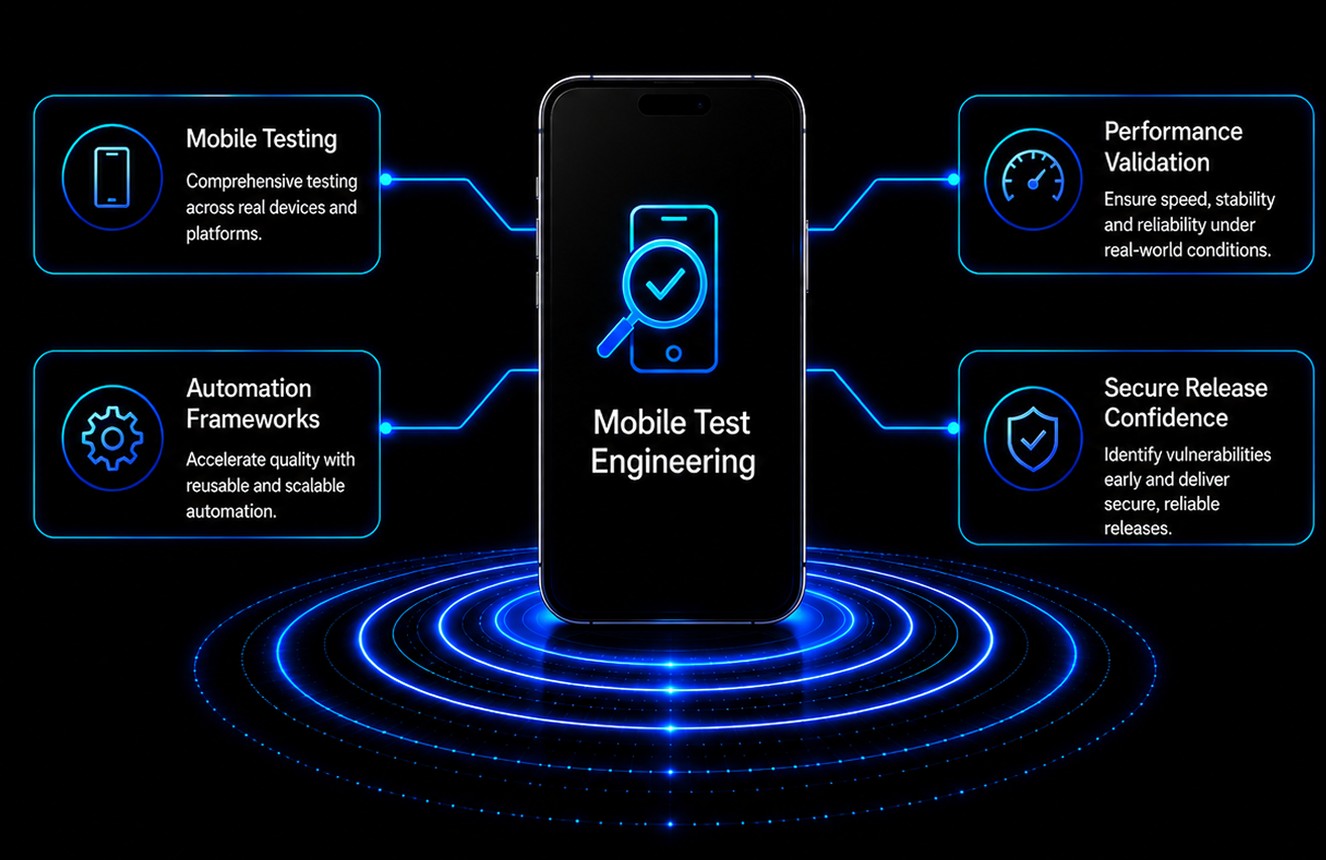
Product Engineering
Mobile Test Engineering
Android · iOS · Web · Cross-Platform
Faster, Stable & Scalable Releases
Our client — a fast-growing mobile product team — was shipping features across Android and iOS at increasing velocity, but their testing function hadn’t kept pace. As the device matrix widened and OS versions multiplied, maintaining consistent quality across every supported environment became an unsustainable manual effort.
Sprint cycles were tightening, release windows were compressing, and the gap between what the team could actually validate and what was going out the door was becoming a serious business risk.
The client's team had no scalable way to validate behaviour across their full device matrix — coverage was inconsistent, manual, and increasingly unreliable as the product grew.
Re-testing across Android and iOS by hand after every release introduced inconsistency between runs and slowed the team's ability to ship with confidence.
Without automation embedded in their pipelines, issues were being caught too late — often only after they'd reached real users in production.
The team lacked a reliable quality signal before each deployment, making release decisions stressful and risk-laden rather than evidence-based.
We defined a layered testing strategy built around real user journeys, covering unit, integration, and end-to-end mobile test scenarios aligned to product risk.
We built reusable, maintainable automation frameworks for Android and iOS, enabling rapid test authoring and stable long-term execution across releases.
We established a hybrid testing model — combining cloud-based real devices with local emulators — to validate across screen sizes, OS versions, and network conditions.
Automated test suites were embedded directly into our delivery pipelines, giving engineering teams fast, actionable feedback on every code change.
We introduced quality gates and release dashboards to track coverage, failure trends, and confidence scores ahead of every deployment.

Defining a comprehensive test strategy that established the overall approach, scope, and objectives for mobile app testing - ensuring every team member had a shared, structured foundation to work from before a single test was written.

Planning and executing a full spectrum of test types across the mobile application - covering functional, performance, security, and usability testing to validate the product against both technical requirements and real user expectations.

Designing and implementing effective test automation frameworks and tooling tailored to the mobile stack - systematically increasing test coverage and accelerating the overall speed of the testing process across every release cycle.

Building and maintaining a structured device and platform matrix - ensuring extensive, repeatable coverage across a broad range of mobile devices, operating systems, and OS versions representative of the client's real user base.

Conducting structured usability testing to evaluate the application's interface, navigation flows, and overall user experience - verifying that every interaction met the expectations and mental models of the target audience.

Implementing continuous monitoring and feedback mechanisms across the live application - tracking performance metrics in production and gathering real user signals to drive ongoing quality improvement beyond the initial release.

We cut regression execution time significantly by replacing manual workflows with scalable, parallelised mobile test automation.
Every release was validated against real devices and real usage conditions - giving the team clear, trusted signal before shipping.
Manual testing overhead dropped sharply, freeing engineers to focus on building rather than repeatedly validating the same flows by hand.
Our device matrix and automation infrastructure scale naturally as new devices, OS versions, and features are introduced — without added engineering cost.